



13 May Systems Change in Kazakhstan’s Ministry of Justice
The Challenge
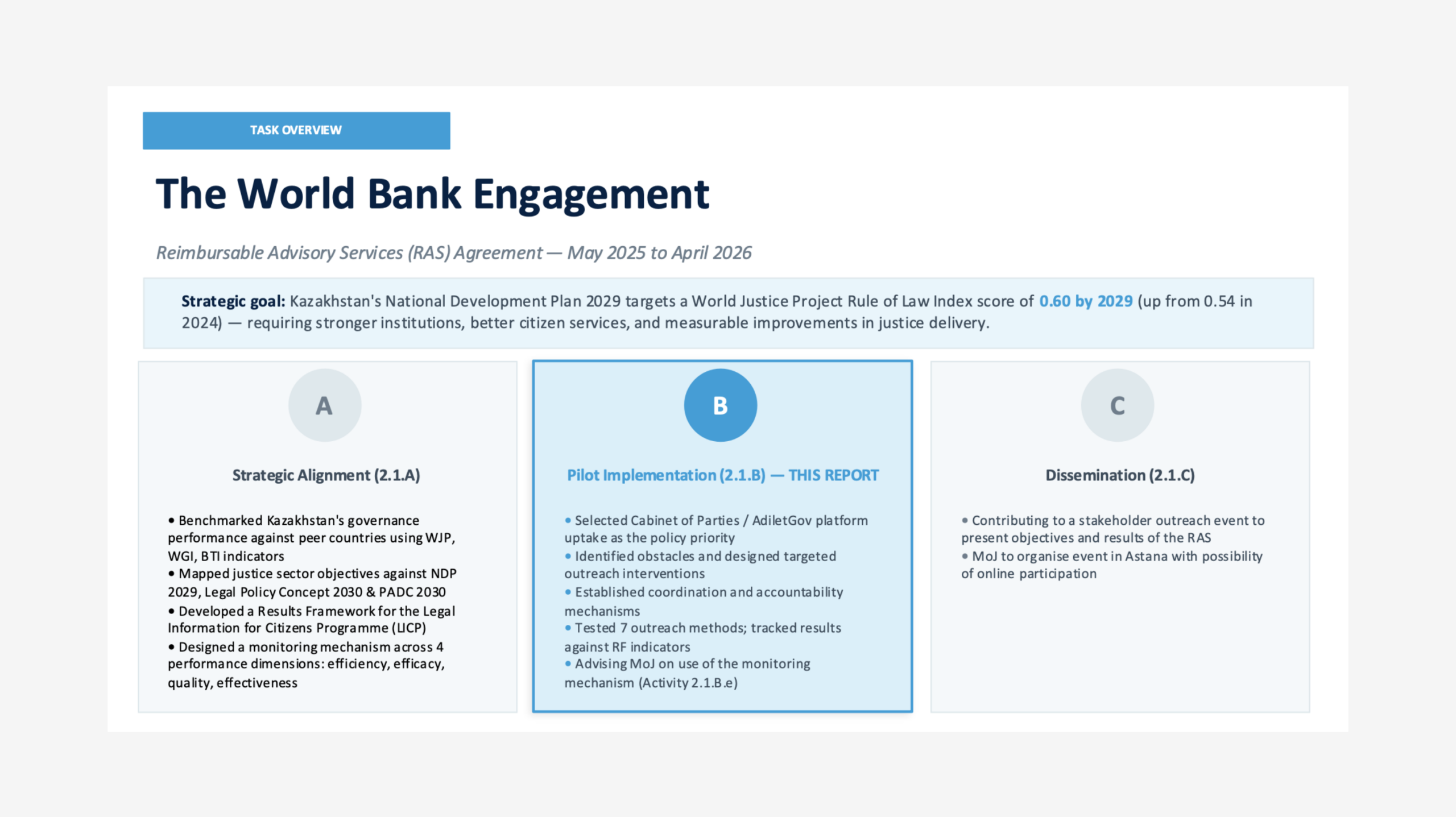
Kazakhstan has set an ambitious goal to become a high-income country by 2029, requiring extensive structural reforms and a significant focus on strengthening the rule of law. The country aims to improve its score in the World Justice Project Rule of Law Index from 0.54 to 0.60 by 2029, addressing key factors such as judicial independence, government accountability, corruption, and protection of fundamental rights.
A core bottleneck was the Ministry of Justice’s (MoJ) capacity to move from strategy to implementation: translating high-level reform goals into concrete, measurable actions that frontline teams could deliver within tight timeframes.
Services: Strategy, Facilitation, Program Design
Sectors: Justice
2025 – 2026
Our Approach
Working with the World Bank and Kazakhstan’s Ministry of Justice, Echo supported an ambitious task involving two key components that aimed to strengthen the MoJ’s strategic planning, implementation and monitoring evaluation and learning capacities:
Strategic Planning: Benchmarking Kazakhstan’s governance and institutional performance, mapping key justice sector objectives and plans, and developing a pilot results framework with clear outputs and outcomes.
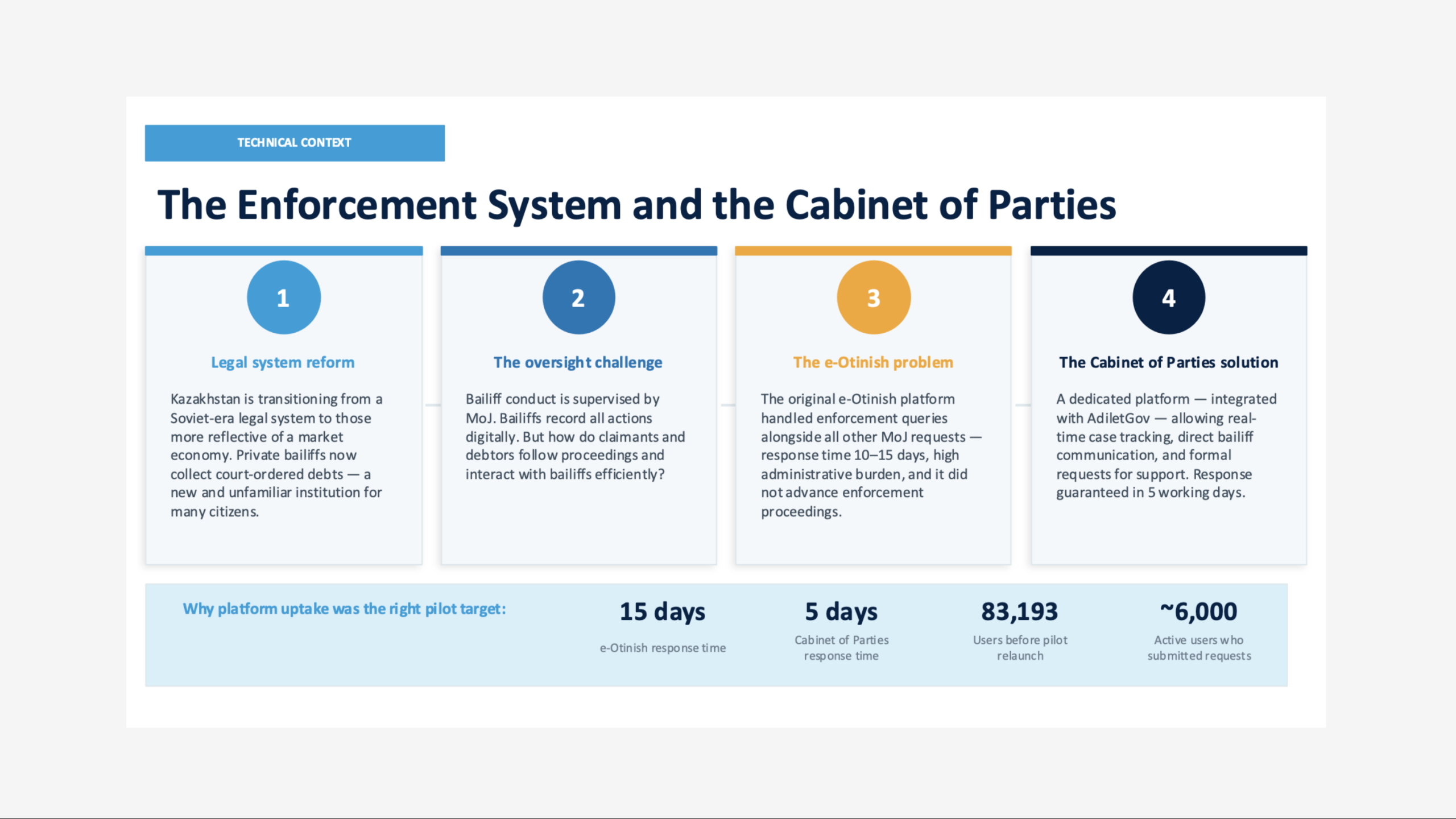
Pilot Implementation: Echo led this part of the task, working directly with Ministry of Justice teams to identify six-month targets, analyze implementation obstacles, design targeted interventions, and establish coordination and accountability mechanisms. The focus of the pilot was increasing citizen uptake of the “Cabinet of Parties” digital service — a platform within the AIS IPR system that allows parties to enforcement proceedings to track case progress, submit appeals to bailiffs and supervisory bodies, and access case documents online, all with significantly faster resolution times (5 working days versus 15 through traditional channels). With approximately 600,000 registered users but only around 6,000 having submitted appeals, the pilot aimed to reach 10,000 appeals by driving awareness and adoption of this underutilised service.
The Impact
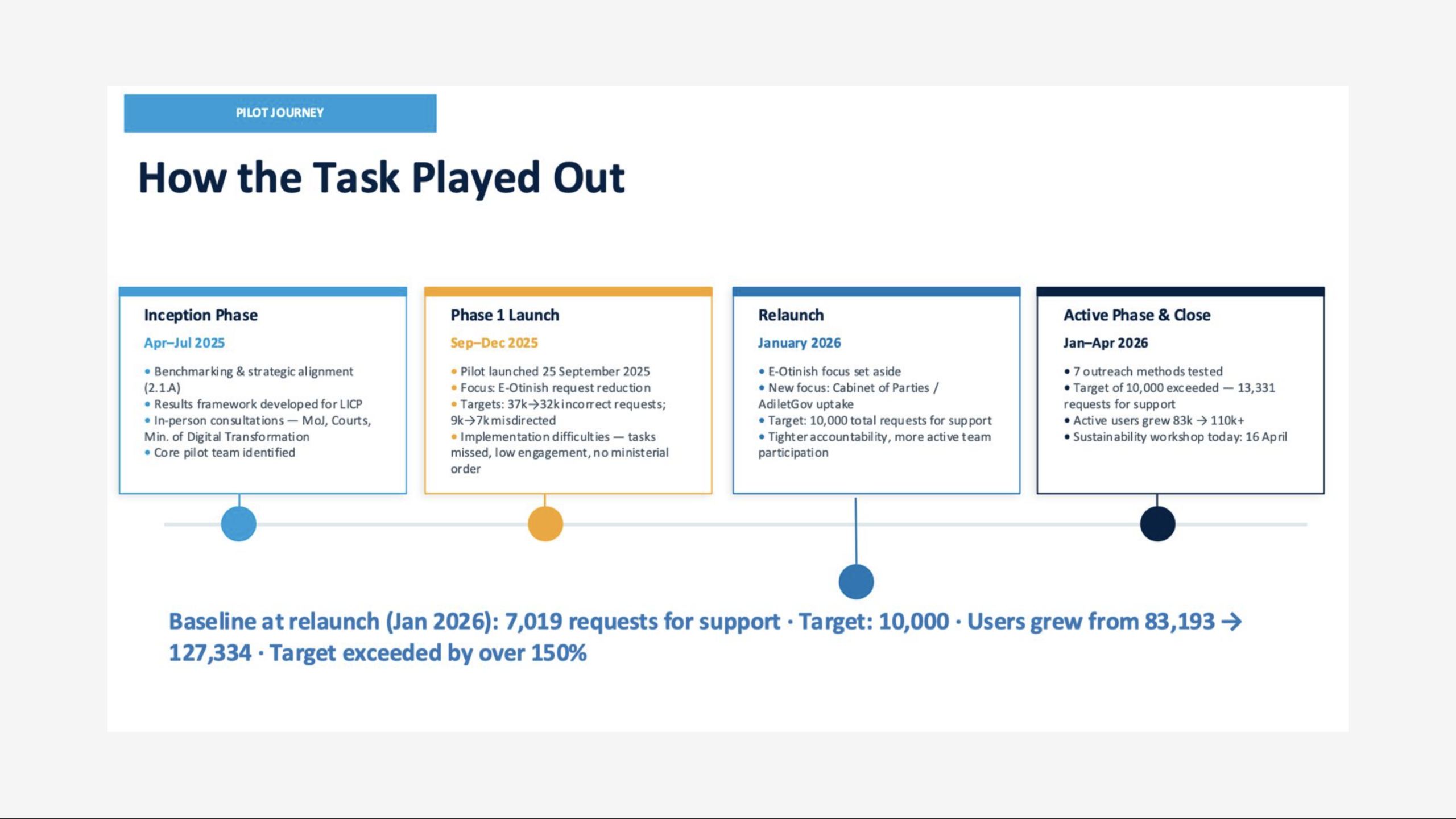
The pilot’s active phase (January–April 2026) delivered results that far exceeded targets:
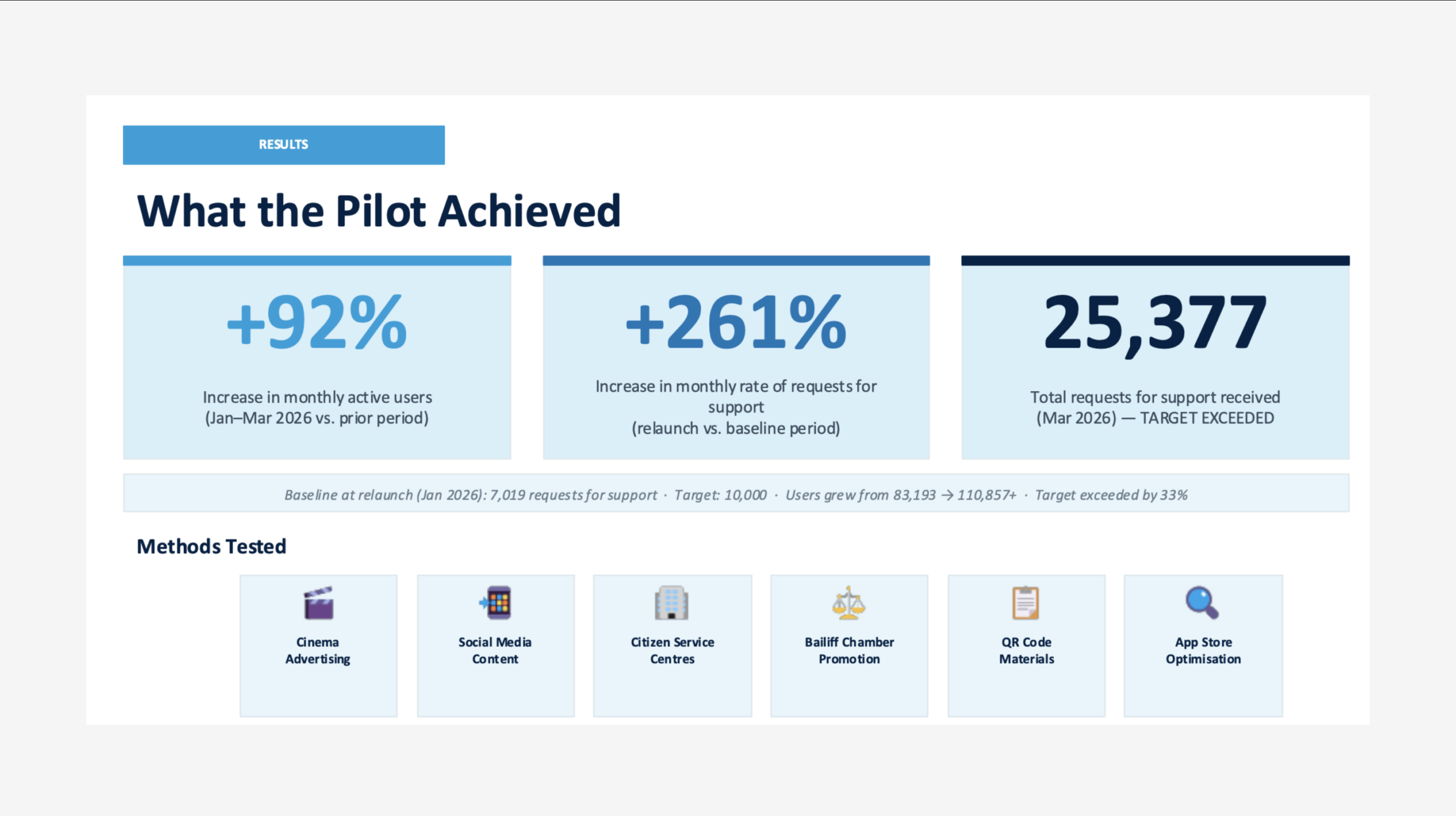
Starting from a baseline of 7,019 requests for support in January 2026, the team set a target of 10,000 — and surpassed it by 154%, reaching 25,377 total requests for support within four months. Monthly active users on the AdiletGov platform grew from 83,193 to over 110,857 — a 92% increase — and the monthly rate of requests for support rose by 261% compared to the baseline period.
These results were achieved by testing seven distinct outreach methods, including cinema advertising, social media content, citizen service centres, bailiff chamber promotion, QR code materials, and app store optimisation.
The engagement has established a tested outreach model and results framework that the Ministry of Justice can now apply to future digital services where citizen awareness and engagement are needed. An inspiring scaling and sustaining phase has now begun.
Gallery:
Gallery:
Gallery:
Gallery:
Let’s start a conversation.
Ready to work?


Ciudad de México
+52 55 22 32 47 58
Astronomos 19
11800 Ciudad de México
Londres
+44 20 7123 4567
One Prince of Whales Road
London NW53LW
Contact: info@astronomos.studio
Gallery:
Gallery:
Gallery:
Gallery:
Gallery:
Gallery:
Let’s start a conversation.
Ready to work?
Ciudad de México
+52 55 22 32 47 58
Astronomos 19
11800 Ciudad de México
Londres
+44 20 7123 4567
One Prince of Whales Road
London NW53LW
Contact: info@astronomos.studio